

Quick answer: digital files are copies you store; an heirloom album is something your family lives with. Files get lost to dead hard drives, forgotten passwords, and phone upgrades — a well-made album sits on the coffee table for decades. The honest answer: have both, but print what matters.
Every week, a mama asks me some version of the same question: do I really need an heirloom photo album, or are the digital files enough? After years of photographing newborns and families at my McMurray studio — and years before that as a pediatric ICU nurse and a CRNA in labor and delivery, where I learned exactly how much a tangible keepsake can mean to a family — my answer hasn’t changed. Files are wonderful. But they are not the thing your children will hold someday.

What actually happens to digital files?
Be honest: where are your photos from 2015? For most of us the answer is “somewhere” — an old laptop, a cloud account with a password we hope we remember, a phone three phones ago. The Library of Congress publishes guidance on preserving personal digital photographs precisely because files are fragile: formats age, drives fail, accounts lapse.
But the failure I see most often isn’t dramatic. Nothing breaks. The files are right there, perfectly safe, in a folder nobody opens.
That is the quiet problem with a digital-only archive. A gallery of four hundred images asks something of you every single time — you have to decide to look, decide which ones, decide what to do with them. And on an ordinary Tuesday with a toddler on your hip, you don’t. The photographs are not lost. They’re just never in the room with you.
None of this is a reason to skip digital files. They’re your archive, they’re how you send pictures to grandparents, and they’re how you reprint something in fifteen years. It’s a reason not to let files be the only place your family’s story lives.
And what about the prints you do make?
Here’s the part nobody mentions. Printing something is not the same as preserving it.
Most drugstore and big-box prints are made on consumer paper with dye-based inks. In a sunny room they can visibly shift within a few years — skin tones go first, usually toward orange or magenta. The print is real and tangible, which is genuinely better than a file nobody opens, but it isn’t built to outlive you.
Archival printing is a different process: pigment inks rather than dyes, acid-free and lignin-free cotton paper, and in framed pieces, conservation acrylic that blocks most UV light. The difference doesn’t show up the week you hang it. It shows up in year twelve, when one print looks the way it did on day one and the other has gone soft and warm.
This is the whole reason I don’t hand my families a folder and wish them luck.

Why does an heirloom album feel so different?
I learned this one personally. The only photographs I have from my oldest son’s first days are hospital snapshots — me exhausted, in nursing pajamas, everything a blur. For years they lived unseen in a camera roll. It wasn’t until I held printed images of my children in my hands that I understood what I’d been missing: photographs become real when they take up space in your life.
An album gets pulled off the shelf on ordinary Tuesdays. It gets pointed at by toddlers who want to see “baby me.” It doesn’t need a charger, a login, or an update. Twenty years from now, it will simply still be there.
There’s something else I notice at nearly every delivery. People slow down. A phone gallery is scrolled at the speed of a thumb; an album is turned at the speed of a hand. The same photographs get three seconds on a screen and thirty seconds on a page, and thirty seconds is long enough to actually remember the day.
What makes an album “heirloom” quality?
The word gets used loosely, so here is what I mean by it specifically.
- Archival materials. Acid-free, lignin-free pages and pigment printing that will not yellow or fade the way consumer prints do.
- Real craftsmanship. Thick lay-flat pages that open without cracking the spine, matted boards substantial enough for small hands, and linen, leather, suede or velvet covers that are bound by hand rather than glued.
- Custom design. Every album at my studio is designed for your gallery specifically, image by image, so the story reads the way the day actually happened — not dropped into a template.
- A guarantee behind it. Every piece I deliver carries a lifetime guarantee. That is not a sales line; it is the practical difference between something manufactured and something made.
This is the heart of the heirloom artwork philosophy my full-service studio experience is built on — photography you can hold, not just scroll.

Album, matted album, or matted print set?
“Album versus digital” is really a smaller question inside a bigger one, because an album is not the only tangible option — and it is not always the right one. Three things I design most often, and who each one tends to suit:
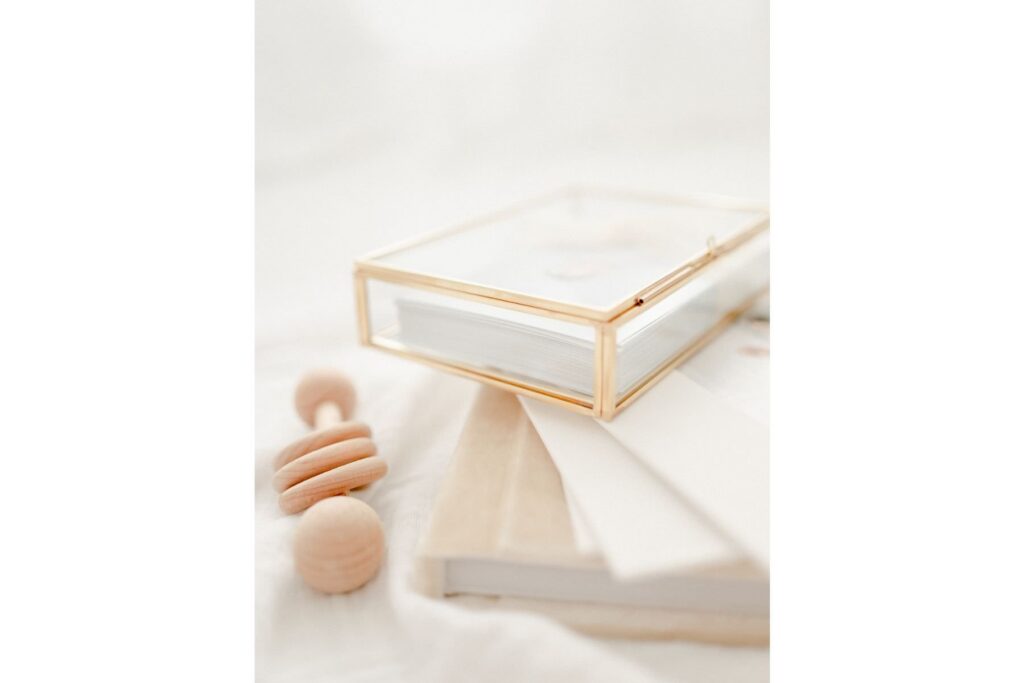
The heirloom album. The full story, start to finish, twelve to forty images designed page by page. This is the right choice when you want the whole session to live somewhere, not just the five favourites. It is the piece families hand down.
The matted album. Smaller, compact enough for a nightstand, each portrait individually matted and bound in linen or velvet. This is the one I’d pick if you want something beautiful and you know you only truly love ten images. It is also, by a wide margin, the most requested grandparent gift I make.
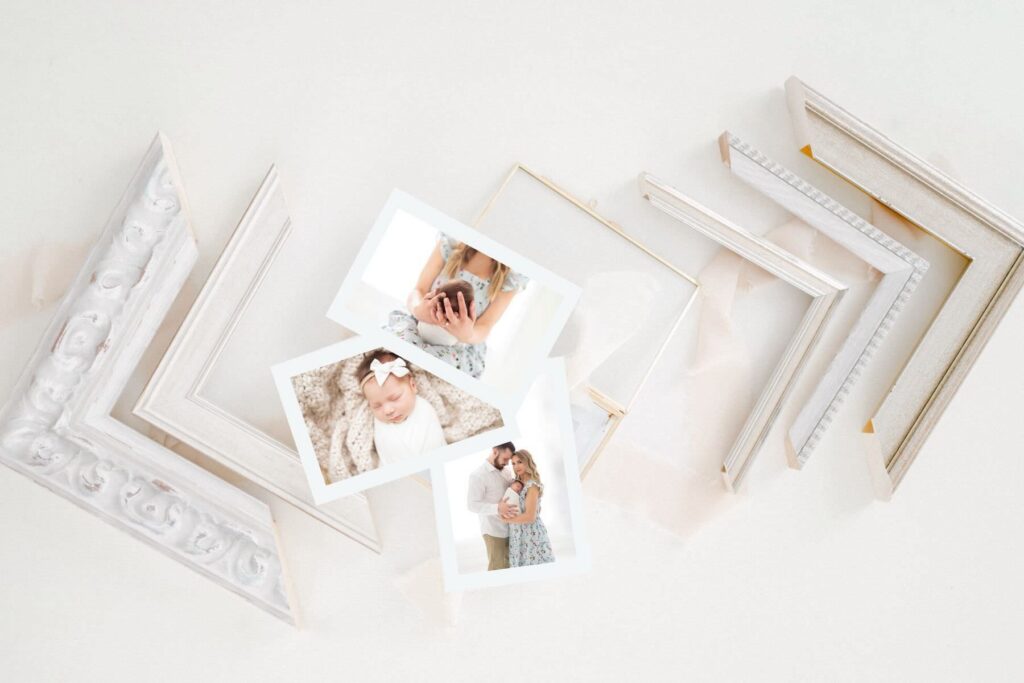
The matted print set in a linen keepsake box. Fine art prints, individually matted, tucked in a box rather than bound. The advantage is flexibility — pull one out to frame when the mood strikes, swap what’s on display, let little ones look through the box on the floor. Choose this if you like the idea of your photographs moving around your home rather than staying put.
There is no wrong answer among the three, and plenty of families end up with a combination. We work that out together at your Design and Ordering Appointment, after you have seen your images, with the actual samples in front of you.
So — album or digital files?
Both, honestly. The files are your archive; the album is your legacy.
Digital files are always available for purchase, and most of my families add them alongside their artwork — I offer a few collections that combine the two as a starting point, then we tailor them to what you actually want. When you sit down at your ordering appointment, we design your album together from the images that made you tear up, and we work out which files come home with you too. Nothing here is either/or.
But if only one of them will still be in your family in fifty years, I know which one I would choose.
What I would do this week, whoever photographs your family
You do not need to hire me to fix this, and you do not need a free afternoon. Three things, none of which take long:
Put your photographs in two places. One cloud account and one physical drive, or two cloud accounts. One copy is not a backup. This is twenty minutes once.
Print one thing. Any one thing. Not an album, not a project — a single image you love, properly printed, somewhere you walk past. The goal is to break the habit of photographs living only behind glass.
Write down where everything is. Which account, which drive, which password lives in which manager. If something happened to your phone tomorrow, could your partner find your children’s baby pictures? For most families the honest answer is no, and the fix is one note.
That is genuinely it. Do those three and you are ahead of nearly everyone.
Frequently asked questions
How many images go in an heirloom album?
Most albums at my studio hold twelve to forty images, designed page by page from your session gallery. We choose them together at your ordering appointment — you are never left to decide alone.
Do I still get digital files if I order an album?
Digital files are always available for purchase, separately from your session fee, and most families who order artwork add them too. Several of my collections combine files and artwork as a starting point and then get tailored to what you want, so you end up with both the archive and the heirloom.
Can an album include images from more than one session?
It can — families documenting baby’s first year often build one album that gathers the whole story, from maternity through the first birthday. Mention it when we plan your first session and I will design with that in mind from the beginning.
How long does an album take to make?
Plan on several weeks from the day you approve your design. These are hand-bound by a professional lab, not printed overnight, and the wait is most of why they last. I will give you a realistic date when we finalize your layout.
What if something happens to my album?
Every piece I deliver carries a lifetime guarantee against defects in materials and craftsmanship. And because I keep your design on file, a replacement or a second copy for a grandparent does not mean starting over.
Is an album worth it if I already have a gallery wall?
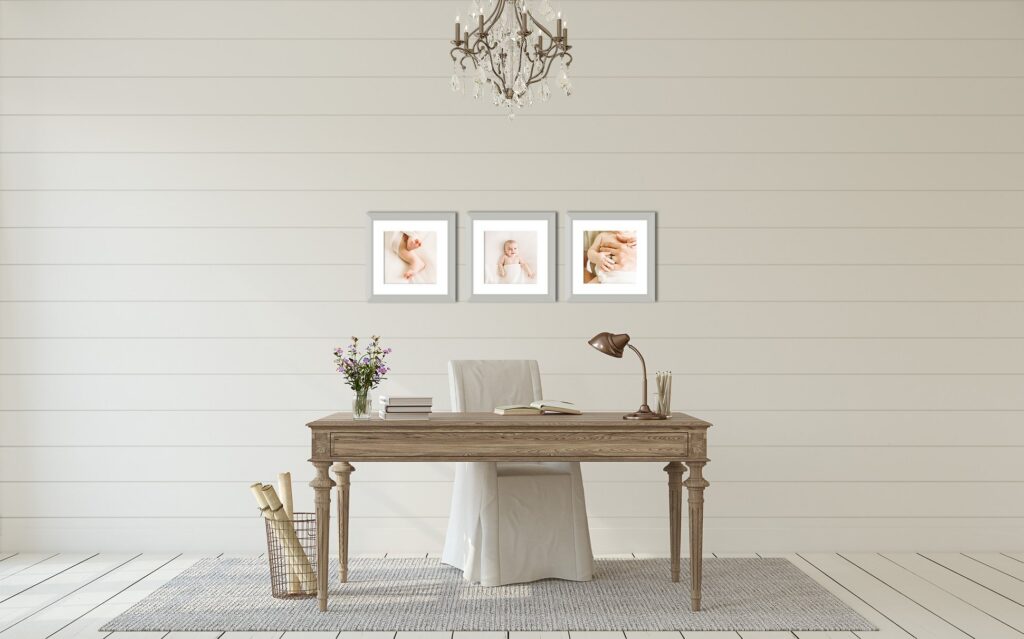
They do different jobs. A gallery wall is what your family sees every day without choosing to; an album is what you sit down with on purpose. Most families who have one eventually want the other.
Ready to preserve yours?
If you are expecting, or your baby is already here and the weeks are moving faster than you expected, I would love to hear from you. Every session at my McMurray studio is built around your baby’s safety and pace, and it ends the way it should — with an heirloom album or framed artwork designed for your home, not a folder you mean to get to.

Brooke is the owner and lead photographer at Petite Magnolia Photography, just outside of Pittsburgh in McMurray, PA. A former pediatric ICU nurse and nurse anesthetist, she brings a level of calm, safety awareness, and genuine care to every session that goes well beyond photography. She specializes in maternity, newborn, baby, and family photography with a focus on documenting the quiet connections, the genuine emotions, and those little moments that make each season of family life worth remembering. Her approach is simple: create timeless images that feel like you. She serves families throughout Pittsburgh and the surrounding communities — including the South Hills, Mt. Lebanon, Upper St. Clair, Sewickley, Peters Township, and Morgantown, WV. She believes photographs should document the love and connection your family shares right now, and that those images deserve to live somewhere more meaningful than a phone camera roll. That’s why she guides her clients through creating heirloom albums, fine art prints, and keepsake pieces they’ll return to for generations.


