

The Petite Magnolia Newborn Safety Approach
Safe newborn photography in Pittsburgh, from a photographer trained in pediatric intensive care — the way a nurse and a mother would want for her own baby
When families are choosing a newborn photographer — especially first-time parents, NICU families, or parents of a baby with reflux or special needs — newborn safety is not a feature. It is often the decision. So I have given it its own page, where you can read carefully, share it with your partner or your pediatrician, and ask me anything that comes up.
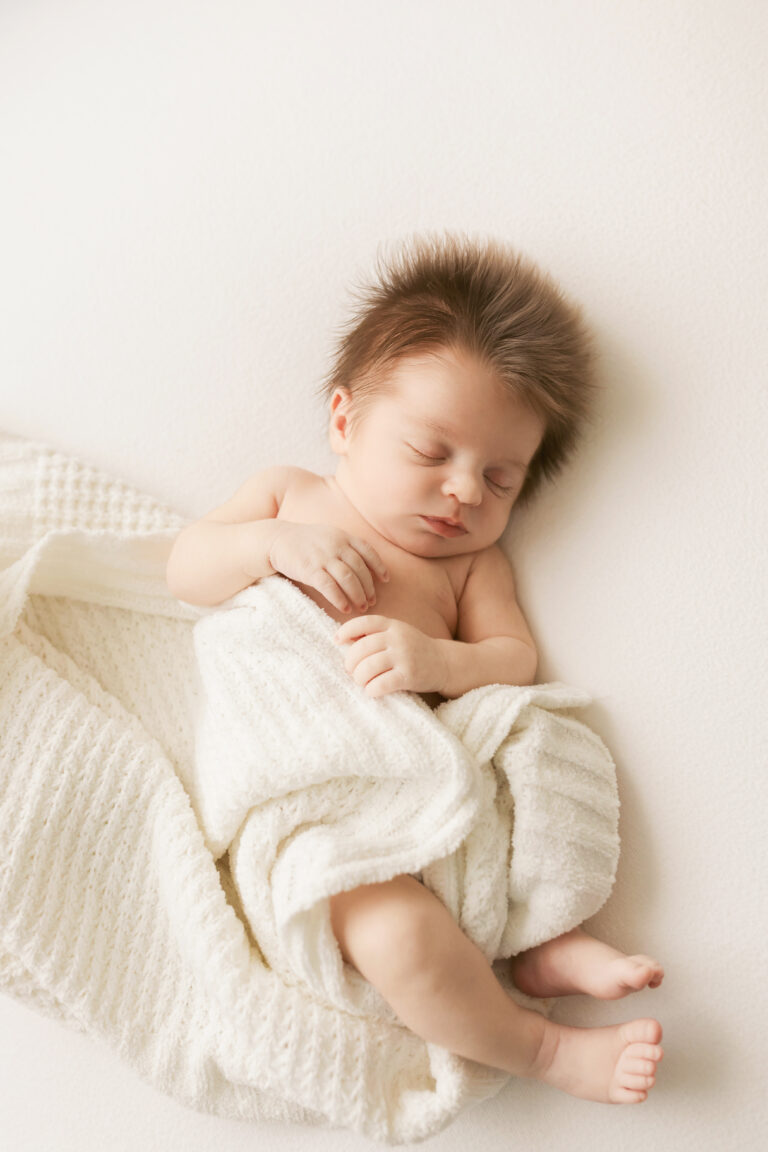
Most studio “safety” pages talk about posing techniques and sandbags. Those matter, and I use them too, but they are the floor of newborn safety, not the ceiling. When you are comparing your options for safe newborn photography in Pittsburgh, I think you deserve to know what actually happens in the room. At Petite Magnolia, every newborn who comes through my doors is cared for by someone who spent years caring for tiny patients in a pediatric intensive care unit and trained as a Certified Registered Nurse Anesthetist before she ever picked up a camera professionally.
That training is not a marketing detail. It is how I approach every newborn session — from keeping your baby warm, to watching their breathing and comfort, to which trending poses I will quietly decline. This page walks you through how that looks in practice.

My nursing background — the short version
Before founding Petite Magnolia Photography, I worked at the bedside in the pediatric intensive care unit for years and went on to earn my masters degree as a Certified Registered Nurse Anesthetist (CRNA). Those roles meant paying close, constant attention to tiny humans who could not tell anyone how they were doing.
That kind of attention is impossible to un-learn. When your baby is on the posing beanbag, I am watching their breathing, their color, and the small cues that tell me they are starting to feel uncomfortable, often before they ever cry. Most photographers learn to watch for safety after they have learned to photograph babies. I learned to care for babies first, and the photography second. It shapes everything about the pace, the posing choices, and the calm of the studio.
For anxious first-time parents, NICU graduates, babies with reflux or colic, or any baby with a complicated medical history, this background is often the reason families choose me.
What safe newborn photography in Pittsburgh actually looks like

Baby-led posing only
Every pose is led by what your baby is willing and able to do that day. I do not force a sleeping baby into a position they have resisted. I do not press a chin onto the chest if a baby’s airway looks restricted. I do not place babies in hanging or unsupported poses. If your baby wants to be wrapped and held the entire session, I wrap and hold and make beautiful, quiet, connected portraits. The most beautiful newborn photographs are the ones where the baby looks safe and peaceful, not posed beyond their comfort.
Watching your baby the whole time
Throughout every newborn session, I keep a close, calm eye on your baby’s breathing, color, warmth, and the small signs of fussing before they become big ones. If anything about your baby changes, the camera goes down and we pause — no exceptions, no rushing.
Keeping your baby warm
Newborns lose heat quickly, and a cold baby is an unhappy baby. My McMurray studio is kept consistently warm for every newborn session, with backup heaters positioned away from your baby for extra warmth as needed. We feed and re-warm between setups instead of rushing through.
Clean and fresh for every baby
Every wrap, headband, hat, bonnet, prop, posing beanbag cover, and surface that touches a baby is washed in hypoallergenic, fragrance-free detergent and sanitized between every session, and I wash my hands before handling your baby. This is non-negotiable, and I have been doing it this way since long before it was a trend.
Parents ask me this one a lot, so I will answer it before you have to: yes, I am vaccinated, and I stay current on my vaccinations the same way I did when I was caring for babies at the bedside. And if anyone in your house is sick the week of your session, please just tell me — we will move your date, no fee and no awkward conversation.
What I decline to do
There are a handful of poses circulating on social media that I don’t do at Petite Magnolia, no matter who asks, because they fall below my safety standards. To me, safe newborn photography in Pittsburgh has to mean the same thing on a quiet Tuesday in my studio as it does in a photo that goes viral. If a setup asks more of a newborn’s body than I think is fair to her, we skip it. I’m always glad to talk through alternatives that give you the same feeling, safely.
Special situations I am comfortable supporting
NICU graduates
Babies who spent time in the NICU often come home on a different schedule, with different feeding patterns, and sometimes with monitors or medications. This is where safe newborn photography in Pittsburgh has to mean more than a pretty setup. I have worked with many NICU graduate families and adapt sessions accordingly — a slower pace, longer feeding breaks, comfort working around monitors or oxygen if they are still in place, and gentle, honest communication with you about what your baby is and is not comfortable with.
Reflux and colic
A refluxing baby is often most comfortable upright and slightly inclined, not flat on a beanbag. I adapt my posing for refluxing babies — more upright wrapping, more parent-held portraits, more vertical compositions — so the photographs are beautiful and your baby is never made uncomfortable for the sake of a pose that does not suit them.
Twins and triplets
Multiples sessions need an extra set of hands. For twin and triplet sessions, I plan ahead with you so a parent is always right beside the babies while I pose and photograph, and if we need more support than that, I’ll have an assistant on hand as well — supporting, never posing.
Babies with medical complexity or special needs
If your baby has any medical complexity — a feeding tube, a heart condition, a recent surgery, a known syndrome — please let me know during your connection call. My nursing background means I am comfortable adapting the session around your baby’s specific needs, and we will decide together what you want documented and how.
Anxious or first-time parents
If the thought of handing your tiny baby to a photographer makes your stomach drop, I hear you, and I get it. Many of my newborn families are first-time parents, and this approach was built with them in mind. You are welcome to be hands-on the entire session, to stay close while I photograph, to ask any question at any moment, and to pause whenever you need to feed, change, or just hold your baby. There is no rushing at Petite Magnolia.

Questions parents ask me about safe newborn photography in Pittsburgh
How old should my baby be for a newborn session?
The easiest window is somewhere between five and fourteen days old, when babies are still curled and sleepy and willing to be moved gently from one position to the next. That said, I have photographed plenty of three- and six-week-olds beautifully — we simply lean into wrapped, awake, and parent-held images instead of the deep curled poses. If your baby is already past that window, please still reach out. I would far rather photograph your baby at four weeks than not at all.
Is newborn photography safe?
In trained hands, yes. The risk in this industry has never really been the camera — it is photographers who learned poses from social media without ever learning infant anatomy, circulation, or airway. That is the gap my nursing background fills. If you are comparing studios, the most useful question is not “do you do the froggy pose.” It is “what is your training, and what would make you stop a session?”
Are you vaccinated?
Yes. I stay current on my vaccinations, the same way I did when I was caring for babies at the bedside. It is one of the most common questions I am asked, and I would rather answer it here than have you work up the nerve to ask.
Is the “froggy pose” safe?
Not the way it usually appears online. That image — baby’s chin resting on her hands, elbows propped underneath — is almost always a composite: two photographs taken with a spotter’s hands supporting the head and body the entire time, then blended afterward in editing. A newborn’s neck cannot hold that position on its own. If a photographer shows you that pose and never mentions compositing, that tells you something worth knowing.
What if my baby will not settle, or will not sleep?
Then we do not force it, and you do not need to apologize. Some babies sleep through the entire session and some are wide awake studying the ceiling. Awake newborn portraits are some of my favorite images to make — those first real moments of eye contact are worth having. I build extra time into every newborn session for exactly this reason, so that a fussy hour is never a crisis. We feed, we rock, we wait. Your baby sets the pace and I follow it.
What if my baby was in the NICU or comes home with equipment?
Tell me when you reach out, and tell me all of it. Monitors, oxygen, a feeding tube, a heart condition, a reflux diagnosis — none of it disqualifies your baby from a session. It simply means we plan differently: a slower pace, longer breaks, positions that work around equipment rather than against it. I have done this many times, and if it would help you feel steadier, I am glad to talk through the plan with you before your date.
Why do you photograph newborns in a studio?
Because a studio lets me control the three things that matter most to a brand-new baby: warmth, cleanliness, and what is within arm’s reach. My McMurray studio is kept warm enough for a baby to be comfortable undressed, every fabric is laundered between babies, and nothing has to be improvised on the day. It also means the wardrobe, the props, and the light are already there waiting, so you can walk in with your baby and your diaper bag and nothing else.
What should I ask when I am comparing safe newborn photography in Pittsburgh?
Ask them what their training is. Ask how they keep a baby warm. Ask what they do when a baby is not tolerating a pose, and whether the image on their website is a composite. You will learn a great deal from how quickly and how specifically someone answers — and if the answers feel vague, that is information too. Choosing someone to hold your days-old baby should not be something you take on faith, and I would genuinely rather you ask me hard questions than wonder about them later.
What “hand-edited” means here

Every Petite Magnolia portrait is personally hand-edited by me. Not run through an AI batch tool. Not handed off to a contractor in a different time zone. Not generated by software trained on someone else’s photography. One image, one set of careful adjustments, one human eye that knows the difference between honoring your real skin and “smoothing” you into someone unrecognizable.
That matters. AI editing tools cannot tell the difference between a baby’s natural newborn skin and an “imperfection” to correct away. They cannot preserve the specific shape of the small hand you want to remember. They smooth away exactly the details that make your child your child. Hand-editing protects the realness of the photograph.
When you receive your final portraits from Petite Magnolia, you are receiving photographs of your real family, honestly edited by a human, made to last.
For parents who want to learn more
If you would like to read more about safe newborn photography, these educators are a good place to start:
- Kelly Brown — a widely respected resource on newborn posing and baby handling safety
- Ana Brandt Education — another widely cited educator in the field

Ready to talk about your newborn session?
Whether you are still pregnant and planning ahead, recently postpartum and a little overwhelmed, or coming home from the NICU and wondering if a newborn session is even possible, I would love to hear from you. Safe newborn photography in Pittsburgh should feel like a relief, not one more thing to research at 2 a.m. I will answer your questions honestly, even if it turns out I am not the right fit for what you need.
To see how a full Petite Magnolia experience comes together, from the very first email to the artwork on your walls, visit The Petite Magnolia Experience.
